Meta Description: Discover how Switzerland, a global leader in innovation and life quality, approaches early childhood education. Explore 5 groundbreaking programs boosting brain development and uncover strategic insights for the future of AI-driven EdTech.
Summary: Switzerland’s early childhood education (ECE) system presents a fascinating paradox. As a global leader in IT and scientific infrastructure, the country surprisingly prioritizes “nature-based physical activities,” “multilingual environments,” and “delicate parent-child interactions” over smart device usage for children aged 0-3. In this post, we analyze 5 Swiss ECE programs that maximize neural development and discuss how these philosophies can shape the future of global AI EdTech.
Hello! I am the CEO of Majungmul WebKids News, an expert in computer hardware and AI business, researching the convergence of global early childhood education and EdTech trends.
While analyzing the global EdTech market, I’ve been particularly drawn to Switzerland, a country consistently ranked #1 in innovation. Switzerland’s ECE system offers a unique perspective: despite having world-class digital infrastructure, the nation channels its resources into ensuring that infants and toddlers build neural networks (synapses) through movement, sensory stimulation, and emotional bonding—not through screens.
Today, we will dive into Switzerland’s 5 most innovative ECE programs and explore how to apply these strategies to future AI EdTech business models.
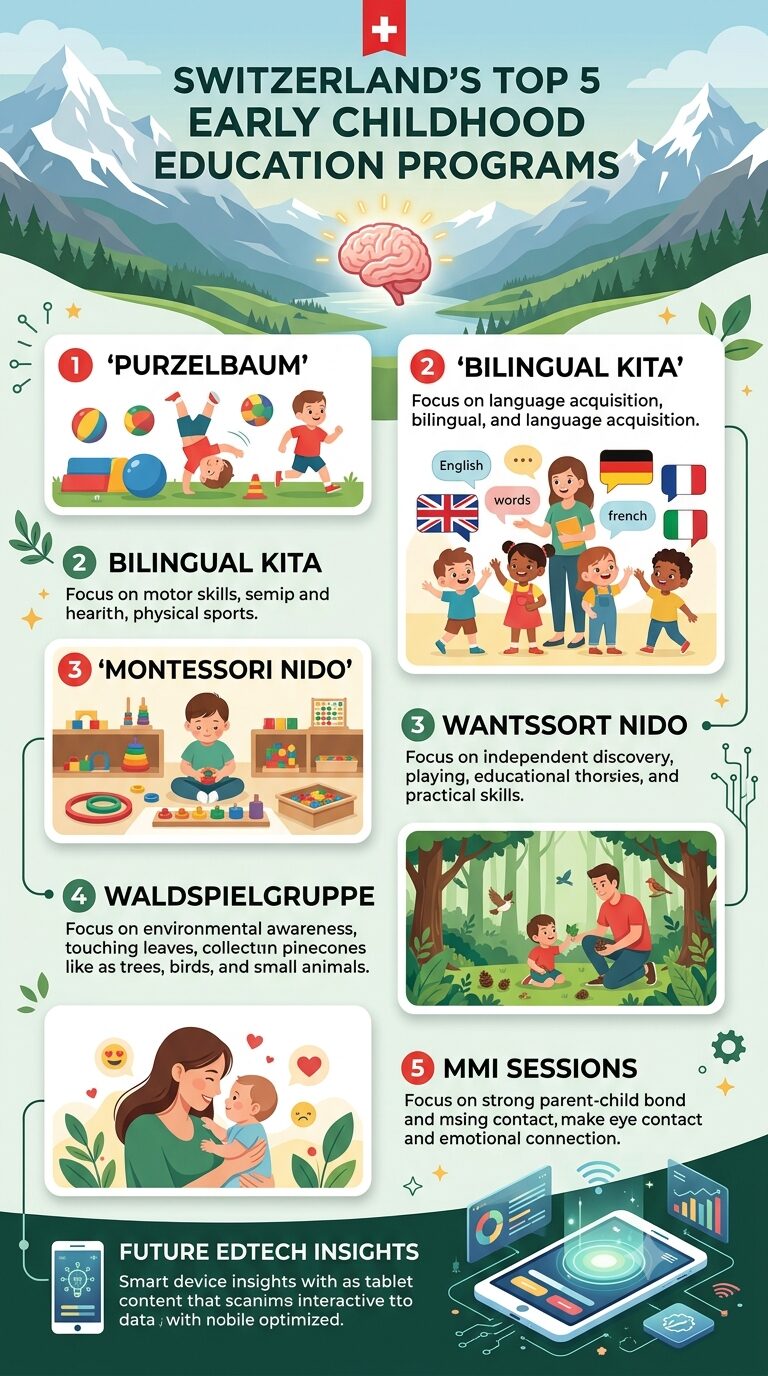
1. Purzelbaum: A Project for Physical Activity Promotion
“Purzelbaum” (meaning “somersault” in German) is a national campaign promoting physical activity for young children.
From age 0 to 3, childcare facilities (Kita) and home play environments are redesigned to encourage jumping, rolling, and climbing. The program operates on clear neuroscientific evidence: physical movement increases cerebral blood flow, which is directly linked to cognitive development. It creates a foundation for spatial awareness and sports sensibility from the very beginning.
2. Bilingual Kita (Early Years): Building Multilingual Neural Networks
Geographically diverse, Switzerland uses four official languages. Consequently, “Bilingual Kitas” where children spend their day in two or more languages (e.g., English and German) are the norm.
The key is that this is not rote, academic learning. Through singing, sports, and storytelling, children are exposed to multiple linguistic environments through play. During the 0-3 age window, when language neural networks are most flexible, this stimulation helps the brain develop in a multi-dimensional way, setting the stage for global talent.
3. Montessori Nido & Toddler: A “Prepared Environment” for Independence
Originating in Italy, Montessori education has been refined in Switzerland to be more nature-oriented. The “Nido” (Italian for “nest”) program for children aged 4 months to 3 years is designed to feel like an extension of home.
Using wooden learning tools scaled to the size of a child’s hands and eyes, it maximizes fine motor skill development and concentration. Caregivers act as observers and guides, allowing children to achieve independence by attempting tasks like feeding themselves. Parents are also trained to create a similar “prepared environment” at home, bridging the gap between care centers and the home.
4. Waldspielgruppe (Forest Playgroups): Holistic Development in Nature
Forest playgroups are a cornerstone of Swiss education. Regardless of rain or snow, toddlers head into the forest to learn through their senses.
Instead of flat, safe indoor surfaces, children navigate uneven forest terrain, fostering gross motor skills and balance. By overcoming small, manageable risks, children develop problem-solving abilities, psychological resilience, and stronger immune systems. This traditional outdoor activity is the gold standard of Swiss development.
5. MMI Parent-Child Sessions: Responsive Parenting Coaching
Operating in Zurich and beyond, programs from the Marie Meierhofer Institut (MMI) offer top-tier “Responsive Parenting Coaching” based on developmental psychology.
Early brain development and emotional attachment depend entirely on the “quality of interaction” between parent and child. In these sessions, experts coach parents on how to read, interpret, and respond to their infant’s subtle cues, babbles, and cries. By learning to mirror their child’s emotions, parents foster a deep sense of psychological stability, forming the basis for social and emotional intelligence.
💡 Strategic Insights: A Powerful Message for Future EdTech
The fact that Switzerland—a hub of high-tech innovation—focuses on “nature-based physical activity” and “human connection” serves as a critical message for EdTech entrepreneurs and parents alike.
- Outdoor Play Analysis Platforms: Future EdTech blue oceans aren’t just about watching videos; they are about O2O (Online to Offline) hardware. Imagine wearable sensors in shoes or watches that analyze outdoor activity levels and balance, then suggest personalized weekend outdoor play solutions for parents via an app.
- AI-Driven Responsive Parenting Coaching: Using AI to reduce parental stress and foster attachment is the next frontier. Imagine a subscription service that provides real-time, data-driven play guidance: “Today, when your child makes this sound, try making eye contact and responding this way.”
Ultimately, the future of EdTech success doesn’t lie in trapping children behind screens, but in how technology can lead children into the vast natural world and support warmer physical and emotional connections with their parents.
Subscribe to [Majungmul WebKids News] for daily insights into the fascinating convergence of global educational philosophy and cutting-edge EdTech!
[Hashtags] #EarlyChildhoodEducation #SwissEducation #BrainDevelopment #ForestSchool #Montessori #BilingualEducation #ParentingTips #EdTech #AIinEducation #MajungmulWebKidsNews #ResponsiveParenting